Attempting a Surface Pro 5 Battery Replacement: Lessons Learned from a Cracked Screen and Proprietary Screws
My Surface Pro 5 (model 1796) had a failing battery, causing it to constantly read 0% to 1% and plunging it into an excruciatingly slow state with throttled CPU clocks. While this makes it tough to use as a mobile device, I figured that if I could successfully replace the battery, I might be able to connect an external monitor and repurpose it as a server. With that in mind, I decided to take on a DIY battery replacement.
What I Wanted to Achieve
- Extend the life of the Surface Pro 5 by replacing the battery myself
The Walls I Hit
- Fragility of the LCD Panel
Due to the strong adhesive, it was extremely difficult to remove even with a heat gun and tools, resulting in a cracked screen.

- The Presence of Proprietary Screws
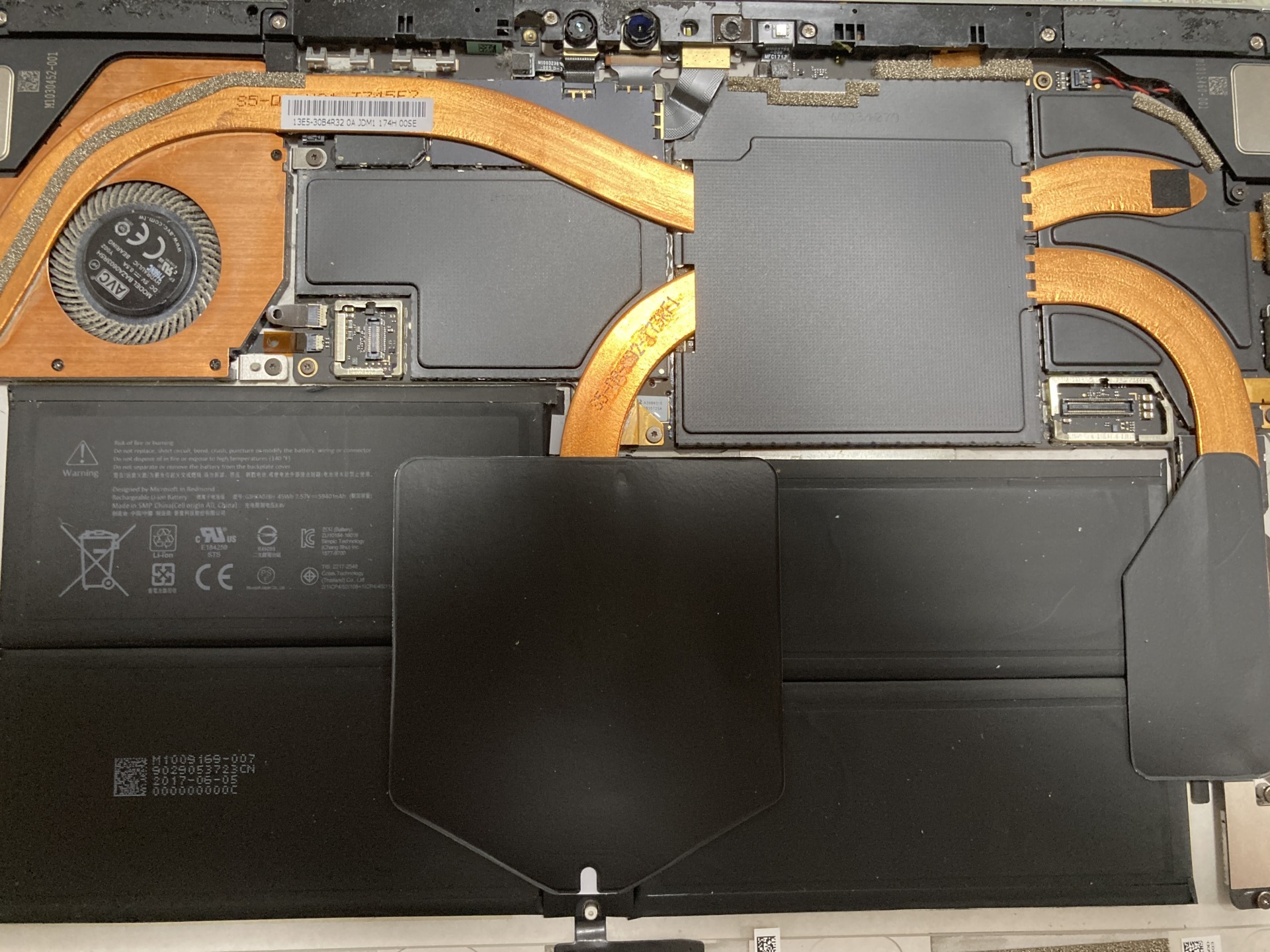
To access the battery, you need to remove the heat pipe and motherboard, but the securing screws are a “star-shaped hexagonal" type.- T6 is too large
- T5 is too small
It falls into an in-between size that couldn’t be removed with the tools I had on hand

Future Possibilities
- I suspect the screws are a proprietary standard like T5H (security Torx) or equivalent to T5.5. Additional tools will be required.
- Even though the screen cracked, if I can manage to replace the battery, there is still room to use it as a dedicated server running off an external monitor.
- The experience itself—realizing that “this isn’t something easily replaced"—became a valuable takeaway.
Conclusion
This attempt was thwarted by a “cracked screen" and “mysterious standard screws," making it an unfulfilled replacement = a complete defeat. However, I gained crucial insights:
- Disassembling the Surface Pro 5 is extremely difficult
- The LCD panel cracks easily and is hard to reuse
- Uncommon, proprietary sizes are used for internal screws
I was able to acquire these important takeaways.
The possibility of replacing the battery still remains, and if successful, it can be used for server purposes combined with an external monitor. For anyone attempting this next, this “story of failure" should serve as a great reference.