Inline Fine Dust Filter for Cyclone Dust Collectors Using Dyson-Compatible Filters and 3D Printing
In my woodworking shop, I use a dust collection setup consisting of a DIY cyclone dust collector—made from a 100-yen-shop bottle and 3D-printed parts—connected in series with a Twinbird cyclone vacuum cleaner.
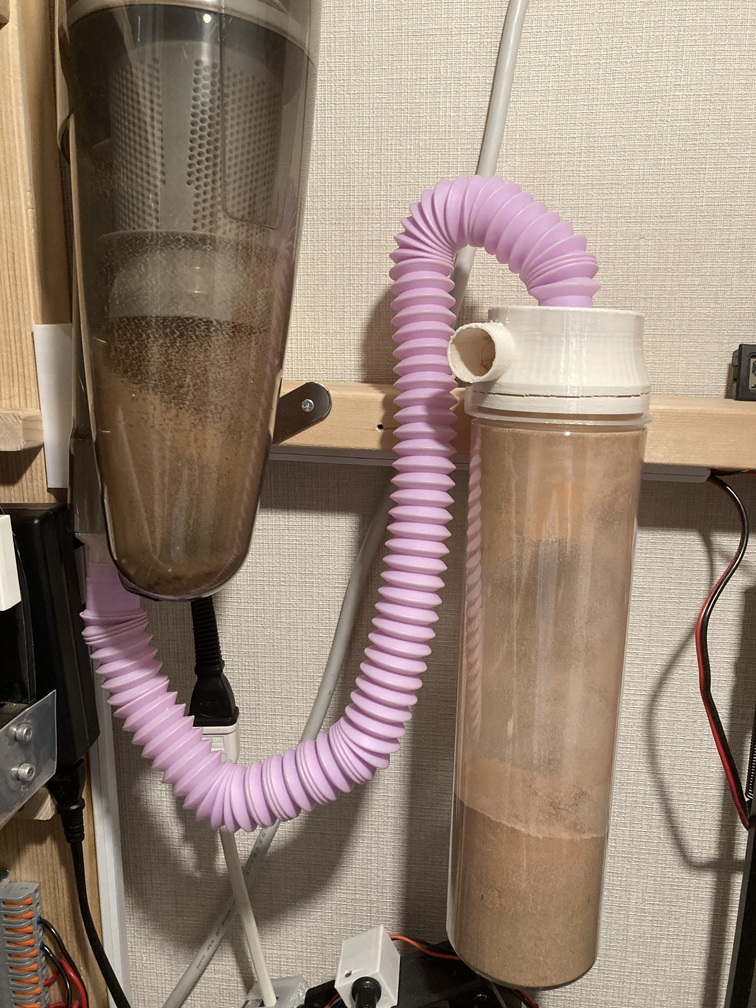
While coarse sawdust from circular saws and routers is successfully separated by the first-stage DIY cyclone, fine dust generated during sanding operations is lightweight and escapes past the centrifugal force toward the exhaust side. As a result, this fine dust passing through the hose would tightly adhere to the inside of the vacuum’s dust case and filter, leading to frequent clogging and the hassle of cleaning the filter.
Introducing an Inline Filter to Block Fine Dust Between the Cyclone and Vacuum Cleaner
The motor of a household vacuum cleaner is cooled by passing the sucked-in air directly through its interior. When the vacuum’s built-in filter clogs and airflow drops, it not only reduces suction power but also lowers motor cooling efficiency, leading to overheating.
To eliminate the hassle of cleaning the vacuum’s internal filter and maintain stable suction performance, I decided to add an inline filter (intermediate chamber) dedicated to capturing fine dust, placed midway along the hose connecting the DIY cyclone and the vacuum cleaner.
Risks of Water Filters and the Size Limitations of a Small 3D Printer
As a method for trapping fine dust, I initially considered a "water filter" (wet type) that passes air through a container filled with water. However, if the vacuum sucks in the micro-droplets (mist) or moisture generated when bubbles burst, it directly risks causing insulation breakdown or failure of the motor. Furthermore, because pressure loss due to water depth cannot be ignored, I switched to the policy of adopting a dry, high-density filter.
When selecting a dry filter, small conical cartridge filters with a total height of about 35mm to 48mm were also candidates. However, their calculated apparent surface area is small at about 26 to 33 square centimeters, raising concerns about rapid clogging caused by a cake layer of fine dust.
On the other hand, a slender pre-motor filter for Dyson vacuum cleaners (approx. 17 cm in total length), which has a large filtration area, can secure a surface area of about 150 square centimeters. However, this presented the challenge that it exceeded the build volume of my 3D printer (100 × 100 × 100 mm), making it impossible to print the housing in a single piece.
Adopting a Dyson-Compatible Filter and 3D Printing a Two-Part Housing
To balance filtration area and cost-performance, I opted for compatible pre-motor filters (a set of two) designed for Dyson V6, V7, and V8 series vacuums.

 https://link.amazon/A002RP6Be
This filter features a stick shape with a total length of about 17 cm, an upper outer diameter of about 4.8 cm, and a tip diameter of about 2.5 cm, designed to cut particles down to 0.3 microns using pleated non-woven fabric. Because it is washable and reusable, it incurs no ongoing running costs.
To overcome the 100 × 100 × 100 mm build volume limit, I adopted a design (fully 3D-printed solution) where the housing is designed and printed in two separate parts: an intake side and an exhaust side.
[Inline Filter Configuration Specifications]
・Filter Used: Dyson V6/V7/V8 Compatible Pre-Motor Filter (Total length approx. 170mm × Max diameter approx. 48mm)
・Connecting Hose Inner Diameter: 21mm (Cross-sectional area approx. 3.5 cm2)
・Filter Apparent Surface Area: Approx. 150 cm2 (Approx. 43 times the hose cross-sectional area)
・Housing Structure: Upper and lower two-part capsule structure via 3D printing (compatible with 100mm cube build limits)
Both ends feature nozzles that directly accept 21mm inner diameter hoses, along with a tapered shape to smoothly expand the airflow. By setting the Dyson-compatible filter inside the two tubular parts printed separately and connecting and sealing them at the center, I completed an inline housing capable of accommodating the 17 cm long filter.
Integration into the Three-Stage Dust Collection System and Fine Dust Blocking Effect
I integrated the completed inline filter into a three-stage dust collection system by inserting it with hoses between the DIY cyclone (1st stage) and the Twinbird vacuum cleaner (3rd stage).
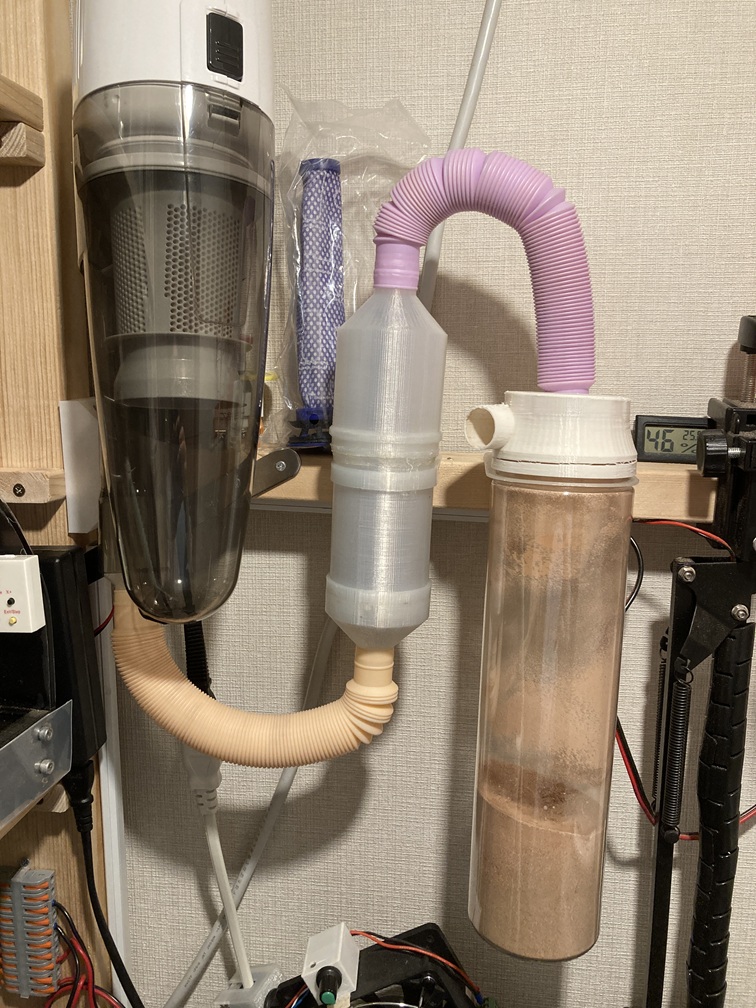
The housing was printed in a translucent filament so that the internal condition could be checked, but upon actual assembly, the contents are only vaguely visible, and the state cannot be discerned at a glance quite as well as initially expected. Even so, as brown wood dust accumulates and the entire filter becomes discolored, it should serve as a rough guide for replacement and cleaning intervals.
Although I haven’t yet conducted dust collection tests with full-scale woodworking, I expect that by placing a filter in the middle with a surface area approximately 43 times the hose cross-sectional area, fine dust can be blocked without significantly compromising suction power, maintaining a clean state inside the vacuum cleaner itself. Since the filters come in a set of two, I plan to operate them by alternating between washing and drying a spare when one gets clogged.
Conclusion
To combat fine dust that slips past the DIY cyclone dust collector and clogs the vacuum cleaner’s internal filter, I fabricated an inline filter to be inserted in the middle of the hose. To suppress pressure loss, I adopted a Dyson V6/V7/V8 compatible filter with a large surface area (total length approx. 17 cm), and solved the 3D printer’s build volume limit (100mm cube) by designing the housing to be printed in three separate parts: Body, Bottom, and Head. While the visibility of the translucent case is limited to a vague hue change, I anticipate that this setup will successfully block 0.3-micron level fine dust right before the vacuum while maintaining suction power.