Amazon Dash Button (Rev.2) Modification Plan
Introduced in 2015, the Amazon Dash Button took the world by storm with its simplicity of ordering products with a single click. However, following the end of its service in 2019, its practical role came to an end. Today, pressing the button only results in a red LED lighting up to indicate a server error, and most are awaiting disposal. Nevertheless, its hardware perfection remains extremely high, retaining its value as a “high-quality IoT terminal" equipped with a low-power wireless module and a robust enclosure.
The contents of this article represent a “plan" based on current research and consideration, and do not constitute a record of successful operational verification or firmware flashing. Please note in advance that following this article will not complete the modification at this stage.
Modifying the Dash Button
The purpose of this project is to completely sever the Dash Button’s communication path from Amazon’s servers and implement custom firmware, transforming it into an independent device capable of sending signals directly to arbitrary services. While it is bound by Amazon’s constraints in its standard state, placing the internal microcontroller under our control makes it possible to freely control Wi-Fi connection behavior, LED lighting patterns, and the timing of transitions to sleep mode. This elevates the device into one with infinite uses depending on the user’s ideas, such as home lighting control, PC wake-up, or integration with specific web services (like n8n).
Goals
The quantitative goal of this modification plan is to establish debug communication (SWD) with a 100% success rate on the 2nd generation (Rev 02 / JK29LP) board. Specifically, we will investigate the feasibility of achieving the following metrics:
- Constructing a stable physical connection with low contact resistance (pogopin jig) for micro test pads with a diameter of about 1mm.
- Using a CMSIS-DAP programmer based on the RP2040 to lift the read protection of the built-in microcontroller “ATSAMG55J19A" and successfully perform a chip erase.
- Flashing custom code to blink (blink an LED) the onboard multi-color LED in a intended pattern.
Challenges in Hacking the Amazon Dash Button
The biggest challenge in the hacking process is the physical and technical constraints unique to the 2nd generation. While the 1st generation (Rev 01) adopted an STM32 microcontroller, this model (Rev 02) is equipped with a high-performance 32-bit microcontroller “SAMG55" made by Atmel (now Microchip), requiring a significantly different analysis approach. The SAMG55 is a powerful chip featuring a Cortex-M4F core and operating at up to 120MHz, but it is protected against reading by the manufacturer.
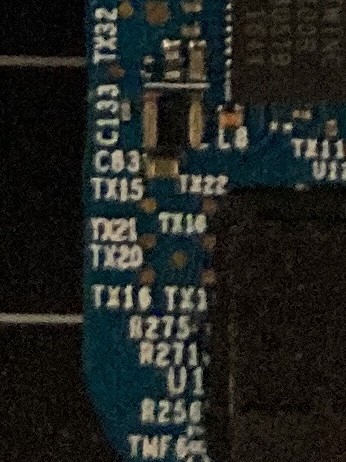
In addition, the test pads on the board (TX20, TX21, etc.) are extremely small, making micro-soldering or the creation of precision jigs essential for accurate signal transmission. Furthermore, the Wi-Fi chip “ATWINC1500B" is an independent module that communicates with the microcontroller via SPI; controlling it requires the implementation of appropriate drivers and advanced command operations to lift the manufacturer’s “seal." According to the datasheet, this chip boasts excellent low-power performance, but unless appropriate sleep control is implemented on the program side, it will quickly drain the internal battery.
Multi-Layered Approach Leveraging Modern Devices
To address these challenges, we will build a solution combining modern devices, open-source software, and the insights of our predecessors. In formulating our strategy, we analyzed the following resources in detail:
Main References and Useful Information
WikiDevi.Wi-Cat.RU (Amazon Dash Button 2 Gen)
The hardware configuration of model number “JK29LP" is thoroughly detailed here. We will use this as a catalog to uncover its “true identity," which is essential for identifying the onboard microcontroller (ATSAMG55J19A) and Wi-Fi chip (ATWINC1500B).
Matthew Petroff (Amazon Dash Button Teardown)
High-resolution teardown photos and initial analysis results are posted here. We will reference this to understand how to open the casing and grasp the internal physical structure, helping to formulate a non-destructive disassembly procedure.
Hackaday.io (Exploring Amazon Dash Button) & GitHub (dekuNukem)
Information on debugging test pads and pin assignments is provided. While it mainly covers Rev 01, it is important as a comparative reference to identify Rev 02 pads (TX41=CLK, TX42=DIO, etc.) and to understand the SWD communication protocol.
ATWINC1500B Datasheet
Details of the Wi-Fi module’s communication protocol are noted here. This will serve as the basis for communication design when operating Wi-Fi with custom firmware in the future and transmitting Webhook packets to an n8n server or the like.
検討 on Specific Solutions
For the programmer, we will utilize an RP2040 on hand (such as a Raspberry Pi Pico). By loading the “Picoprobe" firmware onto the RP2040 and making it function as an industry-standard CMSIS-DAP programmer, we will achieve stable communication with the SAMG55. Regarding the physical connection, to minimize damage to the board, we will create a dedicated programming jig using “pogo pins," which will be detailed in the next article.
On the software side, we plan to use OpenOCD to access the SAMG55 and execute a “chip erase" via specific commands to lift Amazon’s protection. Once the protection is removed, the microcontroller will enter a completely “blank" state, making it possible to load custom firmware. We believe this will establish the foundation for executing communication processes—such as checking available bicycle sharing slots or integrating with calendars—triggered by physical buttons.
Conclusion
The Amazon Dash Button modification plan is a process where users strip away the role of “consumption" designated by the manufacturer and redefine its “function" with their own hands. Carefully making contact with a 1mm pad and unearthing technology from several years ago using modern tools like the RP2040—this spirit of inquiry is the driving force behind the manufacturing philosophy cherished at Nando Kobo. Based on the policies summarized in this article, our next steps will involve building the physical flashing environment and proceeding toward our goal of successfully “blinking the LED." Will the day come when a button destined for the trash can breathes new life through custom code? We will carefully proceed with our verification.