Survival from a GSC Indexation Count of “0”
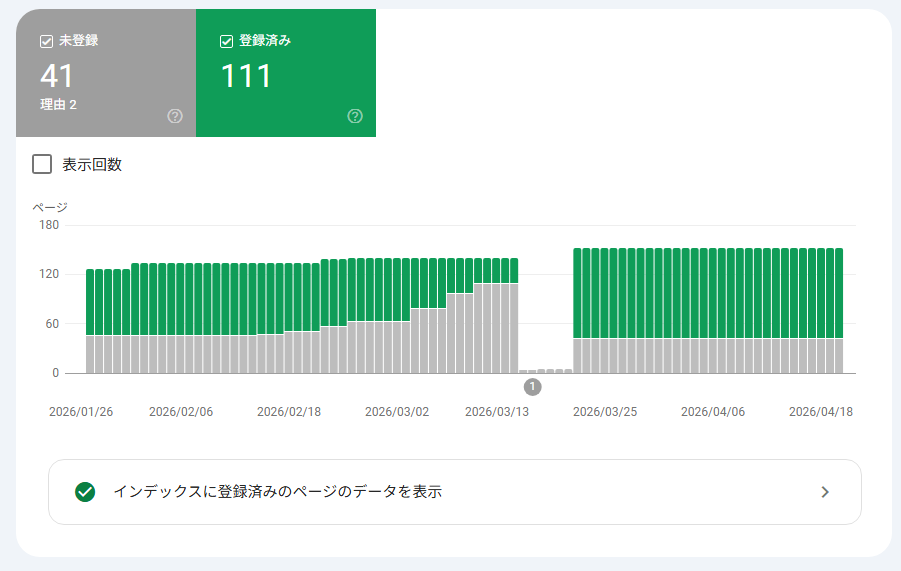
On this blog, “Nando Kobo", we integrated our subdomain (blog.donguri3.net) into our root domain (donguri3.net) for the purpose of brand consolidation. Initially, the transition appeared to be running smoothly thanks to proper redirect configurations. However, about half a year after the integration, we fell into a severe situation where the indexation count on Google Search Console (hereafter GSC) dropped to effectively “0".
The state where 150 accumulated articles were completely erased from search results was a shock threatening the continuation of our site operations. While we suspected it might be a display bug, no signs of improvement showed even after a few days, leaving us with no choice but to conclude that drastic measures through a technical approach were necessary.
Rebuilding Trust and Normalizing Indexation
The primary objective of this response is to promptly recover the vanished indexes while simultaneously reorganizing the site structure on the new domain into a form that is “optimal and easy for Google’s crawlers to understand."
Precisely because it was an unstable period following the domain migration, we avoided vague measures and emphasized the process of verifying and eliminating “what the bottleneck is" one by one based on technical deductions we formulated ourselves. This is not merely a numerical recovery, but a process of trial and error to elevate the site’s technical foundation to the next stage.
Three Technical Hypotheses Suspected of Hindering Recovery
Regarding the cause of the complete disappearance of our indexes, I formulated the following three hypotheses. While these are not definitive facts, they are inferences derived by comparing GSC behavior with the current state of our site structure.
Hypothesis 1: “Complete Drop" of Indexes Due to Domain Migration
This is the hypothesis that while the indexation processing on the new domain side failed internally or was delayed, the index retention period of the old domain (approx. half a year) expired. We suspect that the failure to properly pass the baton to the new domain at the exact timing when the old domain’s evaluation was erased from Google’s database led to this extreme figure of “0 items."
Hypothesis 2: Wasting Crawl Budget Due to Excessive Tags
Through tools like TaxoPress, nearly 1,000 tag pages were generated within the site. This is the hypothesis that many of these were “low-density pages" linked to only a single article, which consumed the crawler’s limited crawling resources. By prioritizing the crawling of meaningless archive pages, evaluations failed to reach the core articles themselves, potentially destabilizing the indexation of the entire site as a result.
Hypothesis 3: Misunderstanding of the Sitemap Hierarchical Structure
This is the hypothesis that the hierarchical structure connecting the “sitemap index" to each “sitemap" was not properly recognized on the GSC side. It is inferred that the mechanism for presenting the site map itself had become complex, or due to plugin output specifications, the search engine got lost in the process of grasping the full picture of the site.
Implementing “Subtraction" and “Forced Notification" Based on Logical Inference
To resolve these hypotheses, we took the following three concrete solutions.
Tag Decluttering and Application of the “Two or More" Rule (Addressing Hypothesis 2)
For the nearly 1,000 tags, we established a clear criterion: “retain only those used in 2 or more articles." Utilizing TaxoPress, we carefully selected about 100 tags and deleted thin, isolated tag pages. This increased the internal link density of the site, optimizing it into a structure that preferentially presents “valuable pages" to crawlers.
Renewal of SEO Management Plugin and Simplification of Structure (Addressing Hypothesis 3)
We switched sitemap management from “XML Sitemap & Google News" to “The SEO Framework." This plugin is lightweight, compliant with the latest standards, and minimizes interference with the standard features of the “Luxeritas" theme. We changed the sitemap hierarchy to a simpler and more accurate one, creating an environment where search engines can reach all articles without getting lost.
Active Notification via Google Cloud Indexing API (Addressing Hypothesis 1)
Through the “Instant Indexing" plugin, we fed the URLs of all 150 articles directly to Google via the Indexing API. Although originally intended for job listings and similar data, we utilized it as a trigger to prompt “re-recognition" after domain consolidation. This shifted our stance from a passive one of waiting for crawler visits to an active approach of explicitly declaring our existence.
Signs of Recovery Born from Technical Consistency
The fact that the indexation count recovered to 110 out of 150 items one month after implementing this series of measures suggests that the direction of our hypotheses was largely correct. In particular, it is inferred that the deletion of wasteful tags and the rebuilding of the sitemap played a crucial role in boosting our evaluation as a new domain.
Regarding the “noindex" determination of the RSS feed, detailed source verification allowed us to isolate it as “behavior according to specifications." Being able to focus on the essential cause—defects in the site structure—without being misled by superficial warnings was the biggest victory in this recovery effort.
Moving away from catering to algorithms as black boxes, “Nando Kobo" will continue to pursue technical rationality at all times and protect the site’s value through our own hypotheses and verifications. For the remaining unregistered articles as well, we intend to steadily recover them by maintaining this “lean and muscular structure."